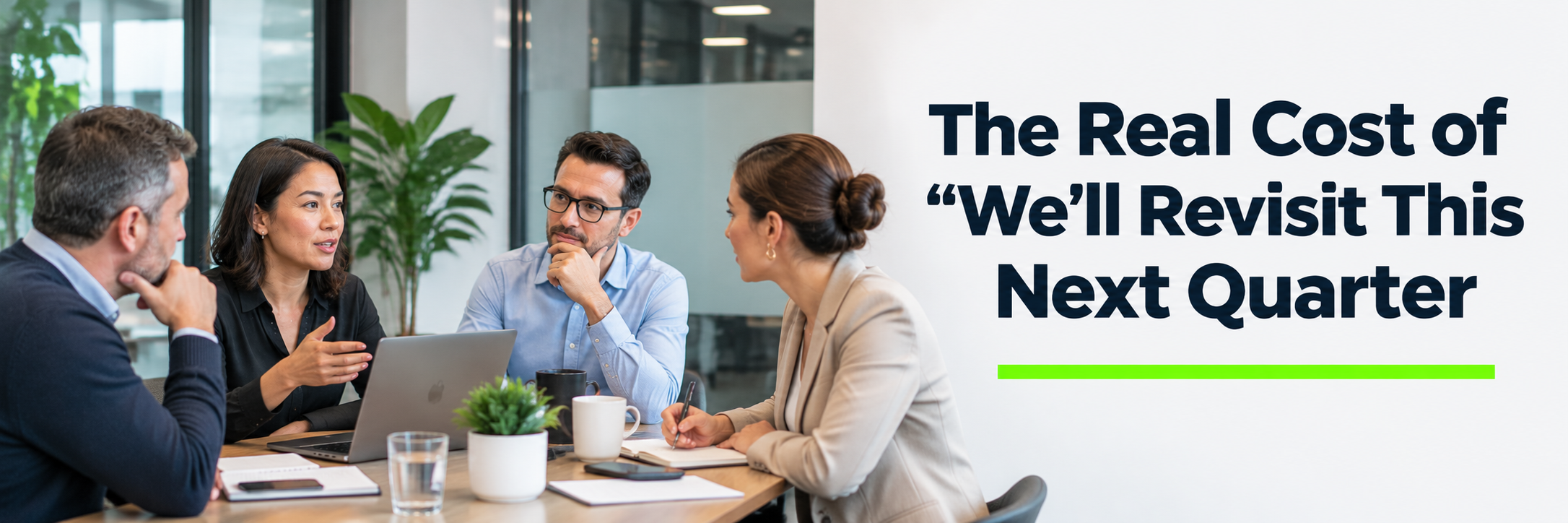
The Real Cost of “We’ll Revisit This Next Quarter"
Delayed decisions don’t show up on a spreadsheet as a cost. They show up as the same unsolved problem, three months later, plus whatever compounded while nobody owned it.
By George Harb
Most teams don’t lose time to bad decisions. They lose it to delayed ones.
“Let’s revisit this next quarter.” “We’ll decide once things settle down.” Both sentences sound responsible in the moment. Both are usually something else entirely: decision fatigue, dressed up in language that sounds like diligence.
The cost of that delay rarely shows up anywhere obvious. It doesn’t appear on a budget line as “deferred decision.” It shows up three months later as the exact same problem, unsolved, often worse, plus whatever quietly compounded while nobody actually owned it.
Why capable teams still stall
This isn’t a capability problem. The teams that stall on decisions are often the most capable ones in the room, which is part of why the pattern is so easy to miss. Smart, experienced people are very good at generating reasons a decision needs more information, more alignment, more time, and every individual reason can sound genuinely sensible.
What’s actually happening underneath is simpler and less flattering: deciding under uncertainty is uncomfortable, and “let’s revisit it later” removes the discomfort without anyone having to admit that’s what just happened.
Safe Work Australia estimates poor workplace mental health costs Australian businesses over $6 billion annually in absenteeism, presenteeism, and compensation claims. Delayed decision-making is rarely counted inside that figure directly, but it sits right next to it: it’s one of the clearest, most common symptoms of a team or a leader operating under sustained pressure without the tools to act clearly under that pressure.
What decision fatigue actually looks like day to day
It rarely looks dramatic. It looks like:
The same agenda item appearing in three consecutive meetings, each time ending in “let’s take this offline”
A decision getting re-litigated from scratch every time new information shows up, instead of updated and moved forward
Leaders quietly avoiding the one conversation that would actually resolve something, in favour of five easier ones
“We need more data” becoming the default response to anything genuinely uncertain, even when the data available is already sufficient to act on
None of these look like a crisis. That’s exactly the problem: a crisis gets addressed. A slow leak doesn’t, until the cost has already compounded well past the point where early action would have been cheap and easy.
Why “just decide faster” doesn’t work as advice
Telling a tired, overloaded team to “be more decisive” is the organisational equivalent of telling an exhausted person to “just have more energy.” It names the gap without closing it.
Decisiveness under pressure isn’t a personality trait some leaders have and others don’t. It’s a trained capacity, built the same way any other performance skill is built: through deliberate practice of the actual mechanism, not through motivational pep talks that wear off by the following Monday.
PwC’s research puts the return on psychosocial safety investment at $2.30 for every $1 spent, specifically because building real capacity, clearer thinking under pressure, less reactivity, less presenteeism from people running on empty, pays back in exactly the kind of outcomes a stalled decision quietly erodes: pace, trust, and momentum.
What actually builds the capacity to decide
Three shifts make the real difference, not just a temporary push:
1. Separate “I need more information” from “I’m avoiding discomfort.” The first is a genuine gap. The second is a pattern wearing the first one’s clothes. Most delayed decisions are the second, mislabelled as the first.
2. Build a default toward deciding with 80% certainty, not 100%. Teams that wait for complete certainty before acting are optimising for a feeling of safety, not for actual outcomes. The data to reach 100% certainty rarely exists, and waiting for it is usually just decision fatigue with better paperwork.
3. Train the underlying state, not just the process. A better decision-making framework doesn’t help a team that’s reactive, depleted, or running on stress by default. The framework only works once the people using it have the actual nervous-system capacity to stay clear and composed while they use it, which is a trainable state, not a fixed trait.
That third point is where most corporate training stops short. It teaches a framework and assumes the capacity to use it well under real pressure is already there. Often, it isn’t yet, and that’s the actual gap worth closing.
A quick test for your next stalled decision
Before the next “let’s revisit this later” leaves anyone’s mouth, it’s worth asking two plain questions out loud: what specific new information would actually change this decision, and is there a real date by which that information will exist? If the honest answer to either is “none, really” or “no, not really,” that’s not a decision being responsibly deferred. That’s a decision being avoided, with a more comfortable label attached to it.
It’s a small test, but it tends to surface the difference quickly, and it’s a lot cheaper to ask than to discover the real cost three months later, after the problem has had time to compound.
If you’ve read our piece on psychosocial safety at work, this is the same underlying cost, specifically as it shows up in stalled decisions rather than absenteeism or turnover.
Where this gets built, not just discussed
This is exactly what Recode. Rise. Reclaim. is built to install, not a motivational day that fades by the following Monday, but the actual neuroscience-based process behind staying clear, composed, and decisive under real pressure.
Group rate is $400 per person for teams of five or more, open until 22 November. If your team recognises this pattern, you can find the full details on the event page, or reach out directly to talk through what this could look like for your organisation.