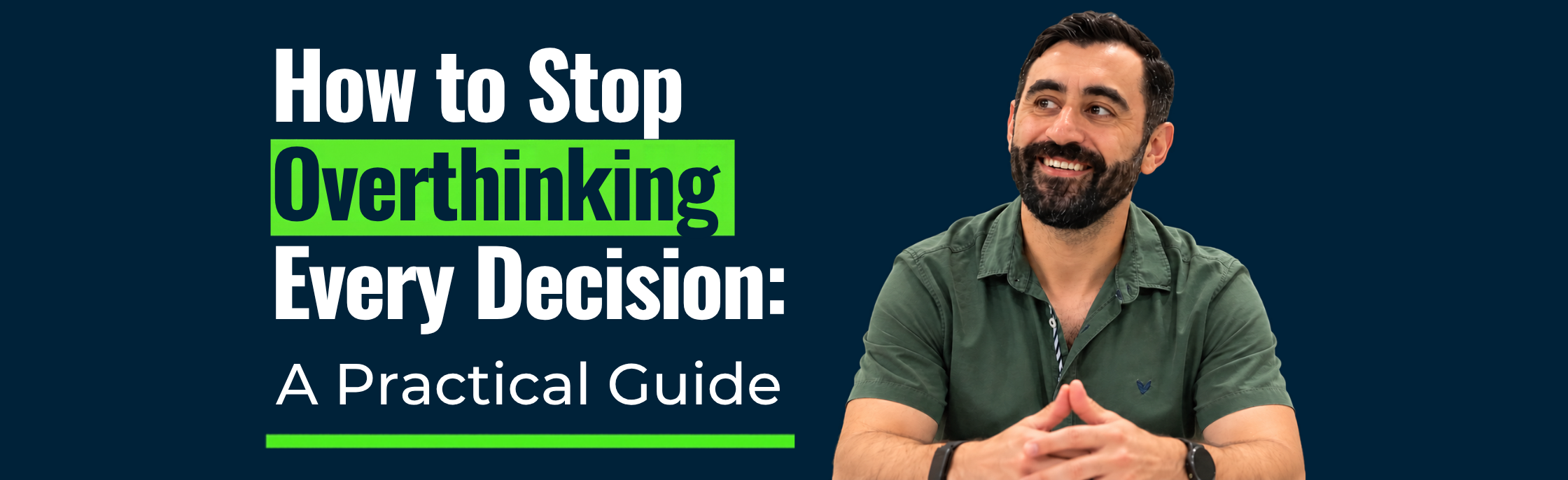
How to Stop Overthinking Every Decision: A Practical Guide
Not every hard decision is a clean 'hell yes or no.' Here's a practical, neuroscience-based way to decide with real certainty instead of overthinking it.
By George Harb
There's a decision-making rule that's become popular advice: if it's not a hell yes, it's a no. Simple, decisive, clears the fence-sitting. And for some decisions, it genuinely works.
But if you're someone who overthinks hard decisions, that rule can make things worse, not better. Because when you're the kind of person who runs every option through a dozen what-ifs before you can even feel anything about it, waiting for a "hell yes" can mean waiting forever. The feeling never arrives clean, so the decision never gets made, and you're left assuming something's wrong with you for not feeling more certain.
Nothing's wrong with you. You're just using the wrong tool for how your mind actually works.
Why "hell yes or no" doesn't work for everyone
That framework was built for a specific kind of person: someone whose hesitation usually comes from politeness, obligation, or a fear of disappointing others. For that person, the rule cuts through noise fast. It forces a gut check instead of a socially-polite maybe.
But if your hesitation comes from somewhere else, from genuinely not trusting your own judgment yet, from years of rehearsing "better safe than sorry" until it became automatic, the rule doesn't cut through anything. It just adds one more thing to feel uncertain about, because now you're also unsure whether what you're feeling even counts as a hell yes.
The rule assumes clarity is already available and just needs permission to be acted on. For a lot of people, the actual problem is upstream of that. The clarity itself isn't there yet, not because the decision is genuinely unclear, but because the identity making the decision hasn't been trained to trust its own read.
The real problem isn't the decision
This is the part that surprises most people I work with: the specific decision in front of you is rarely the actual problem. The pattern underneath it is.
If you've spent years talking yourself out of things, softening hard conversations, deferring to what will keep the peace, that's not a personality trait. It's a rehearsed default, built the same way any habit gets built, through repetition. And a rehearsed default doesn't get overridden by a snappy new rule. It gets changed by interrupting the pattern and installing a different one, deliberately, more than once.
That's the actual gap between someone who can apply "hell yes or no" cleanly and someone who can't yet. It's not that one person is more decisive by nature. It's that one of them has already done the underlying work, and the other hasn't started it.
A better question for the rest of us: what would the aligned version of you do
Instead of chasing a feeling that may never show up on command, try asking a different question: not "does this feel like a hell yes," but "what would the version of me who isn't negotiating with fear actually do here."
That question does something the first one doesn't. It doesn't ask you to locate a feeling. It asks you to picture a specific version of yourself, the one who already knows what he wants and isn't managing everyone else's opinion of the outcome, and then act from there. You don't need to feel certain first. You need to decide who's deciding.
I used this on a conversation I'd avoided for months, a boundary I needed to set and kept finding reasons to delay. There was no "hell yes" moment. There was just a decision to stop letting the anxious version of me run the meeting, and let the aligned one speak instead. Direct. Calm. No over-explaining. The world didn't end. If anything, the other person respected it more, not less.
How to actually use this
Next time you're stuck on a decision that isn't producing a clean yes or no, try this instead of waiting it out:
First, name which version of you is currently driving. Is it the version managing how this looks to other people, or the version who actually knows what's true for him?
Second, ask the aligned-version question directly: what would that version of me do here, if he wasn't negotiating with fear first?
Third, act on that answer in the smallest concrete way available today, not the whole decision at once, just the next honest step. Alignment is built through action, the same way any pattern is, not through thinking about it until it feels resolved.
Do that enough times on smaller decisions, and it gets easier to trust on the bigger ones. That's not a mindset shift you talk yourself into. It's a skill you install through repetition, the same way everything else in this work gets built.
A quick example
Picture someone weighing up whether to raise their rates with a long-standing client. There's no obvious "hell yes" here, just a knot of competing worries: will they leave, will it feel greedy, is now even the right time. Waiting for certainty to arrive on its own could take months, because certainty was never going to show up first.
Run it through the process instead. First, name the version currently driving: the one quietly afraid of being seen as difficult, or the one who actually knows their own worth. Second, ask what the aligned version would do, not the anxious one negotiating on his behalf. Third, take the smallest honest step today, which might just be drafting the email, not sending it yet. The certainty doesn't arrive before the action. It arrives because of it, once the aligned version has actually been given the wheel a few times in a row.
You don't need certainty to decide; you need alignment
If you've been waiting for a decision to feel obviously right before you'll act on it, and that feeling keeps not showing up, that's not a sign you're broken or indecisive by nature. It's a sign the identity making the decision hasn't been trained to trust itself yet, and that's a completely different, much more solvable problem.
This is the same pattern-level work I wrote about in "How to Overcome Self-Doubt and Limiting Beliefs," just applied specifically to the moment of deciding rather than the broader pattern of doubt underneath it. If that piece resonated, this is the practical extension of it.
If you want to build this properly, not just read about it, that's exactly what Recode. Rise. Reclaim. is built for: a full day in Sydney where we do this work directly rather than just discuss it. You can secure your seat, or book a free live Q&A with me first if you want to ask anything before deciding.
George Harb
Dual Elite Neuroencoding Specialist